
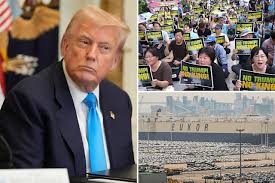

South Korea Dodges a Trade War Bullet: Trump’s 15% Tariff Comes with a $350B Deal
In a headline-making development from Washington, President Donald Trump has announced a new trade agreement with South Korea that imposes a 15% tariff on imports from the country—down from a previously threatened 25% rate. Despite the headline tariff hike, the deal is being framed as a strategic win for both nations, with South Korea securing tariff parity with Japan and the EU, and Washington clinching major investment commitments totaling $350 billion.
The agreement—announced just before Trump’s self-imposed August 1 tariff deadline—includes massive South Korean investments in the U.S., energy purchases, and long-term cooperation in shipbuilding and semiconductors.
Why This Deal Matters
Avoiding the 25% Tariff Hammer
South Korea, a vital U.S. ally and major exporter of computer chips, steel, and automobiles, was staring down the barrel of a 25% tariff on exports to the U.S. The final deal, announced after last-minute negotiations in Washington, trims that back to 15%, matching terms recently secured by Japan and the European Union.
“The United States of America has agreed to a Full and Complete Trade Deal with the Republic of Korea,” Trump wrote on Truth Social, signaling a resolution just before the broader round of global tariffs was set to escalate.
Lee Jae Myung: “We Have Overcome a Major Hurdle”
South Korean President Lee Jae Myung called the agreement a breakthrough for his administration, which took office in June. In a statement posted to Facebook, Lee said the deal puts Korean exporters on equal or better footing than competitors and removes significant uncertainty from the country’s trade outlook.
“We have eliminated uncertainty surrounding export conditions,” Lee wrote, emphasizing the comparative advantage South Korean exporters now have over countries like India and Brazil, which face 25% and 50% tariffs, respectively.
Lee also announced the creation of a $350 billion investment fund, with $150 billion specifically allocated to shipbuilding partnerships between the two nations.
The Investment Breakdown: $350B, LNG, and Tesla
$350 Billion U.S. Investment Fund
According to President Trump, South Korea has committed to investing $350 billion into the U.S. economy, though the specific structure and timeline remain vague. Trump mentioned the projects would be “selected by him,” with additional details to follow.
$100 Billion in U.S. Energy Purchases
In addition to capital investments, South Korea has agreed to purchase $100 billion worth of American liquefied natural gas (LNG) and other energy products—a move that aligns with Trump’s longstanding strategy of promoting U.S. energy exports.
Mega Deals with Tesla
As part of the agreement’s wider industrial cooperation:
-
Samsung Electronics signed a $16.5 billion deal with Tesla to supply next-gen semiconductor chips.
-
LG Energy Solution reportedly inked a $4.3 billion battery supply agreement with Tesla, focusing on energy storage systems.
These deals signal strong corporate alignment and reflect how major South Korean conglomerates are preemptively adapting to shifting U.S. trade dynamics.
Tariff Impact on South Korean Exports
Autos Get Relief
Tariffs on South Korean-made cars bound for the U.S. will now be capped at 15%, instead of the previously threatened 25%. This is critical for brands like Hyundai and Kia, which have been aggressively expanding their U.S. market share.
No Additional Tariffs on Chips, Pharma
The South Korean presidential office confirmed that semiconductors and pharmaceutical exports will face no worse treatment than competing exports from Japan or the EU. That’s a relief for chipmakers like SK Hynix and Samsung Biologics, who were bracing for tariff shocks.
No Concessions on Rice and Beef
In a win for domestic farmers, South Korea’s rice and beef markets remain closed to new U.S. imports. This avoids politically sensitive concessions in the agricultural sector that could’ve triggered backlash at home.
Strategic Timing: U.S. Turns Up Pressure on Others
The timing of the deal is no accident. Trump has used his August 1 deadline to escalate tariffs on countries that failed to cut bilateral deals. On the same day South Korea secured its agreement:
-
India was hit with 25% tariffs.
-
Brazil got walloped with a staggering 50% tariff rate.
These developments further underscore how South Korea’s compromise at 15% may be perceived as a strategic escape from much harsher outcomes.
A White House Visit and More Deals?
President Trump said Lee Jae Myung will visit the White House within two weeks, signaling further bilateral engagement. Additional investments and trade arrangements are expected to be rolled out during or after the visit.
Meanwhile, Trump’s America First trade doctrine is gaining steam, with each bilateral deal forming part of a broader play to reorient U.S. trade flows and reduce the deficit—on Trump’s terms.