
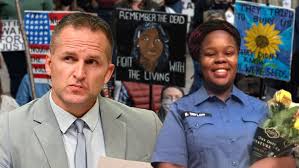

First Prison Sentence in Breonna Taylor Case Marks Milestone in Fight for Police Accountability
In a landmark decision five years after the killing of Breonna Taylor, a federal judge on Monday sentenced former Kentucky police officer Brett Hankison to nearly three years in prison for using excessive force during the botched 2020 raid that resulted in Taylor’s death. The sentencing marks the first time any officer involved has received prison time—despite the Justice Department’s surprising recommendation of a one-day sentence and supervised release.
Breaking From DOJ, Judge Sends Hankison to Prison
“No Prison Time Is Not Appropriate,” Says Judge Rebecca Jennings
U.S. District Judge Rebecca Grady Jennings sharply rejected the Department of Justice’s request for leniency. She sentenced Hankison to 33 months in prison and three years of supervised probation, stating that she was “startled” more people weren’t injured in the chaotic, late-night police raid.
“No prison time is not appropriate,” the judge said during Monday’s hearing. “There must be consequences for such reckless conduct.”
Hankison, who fired 10 bullets blindly into Taylor’s apartment—including through covered bedroom windows and into a neighboring unit where a couple and their five-year-old child were sleeping—was found guilty of civil rights abuse in November 2024.
DOJ’s Light Sentence Request Sparks Outrage
Psychological Stress Cited as Mitigating Factor
The Justice Department, now under President Donald Trump’s second administration, had requested just one day in jail for Hankison, citing the former officer’s psychological stress during the lengthy legal battle.
In their memorandum, Assistant Attorney General for Civil Rights Harmeet K. Dhillon and Senior Counsel Robert J. Keenan emphasized Hankison’s emotional toll and clean record since the incident.
But for many legal experts and activists, the DOJ’s position was yet another sign of waning federal commitment to police accountability under the current administration. Critics argued that such leniency would undermine public trust in the justice system, especially in cases involving police violence against Black Americans.
Civil Rights Fallout and the Trump Administration’s Retreat
Louisville Consent Decree Quietly Abandoned
Adding to the controversy, the Trump Justice Department in May 2025 canceled negotiations for a consent decree with the city of Louisville. Such an agreement would have allowed the federal government to supervise reforms in the Louisville Metro Police Department, including changes to training, use-of-force policy, and internal investigations.
This move effectively killed a policy pipeline designed to prevent another tragedy like Breonna Taylor’s—and was seen by many as a betrayal of the broader police reform movement.
The Raid That Shocked the Nation
A Case That Sparked Protests and Global Outrage
Breonna Taylor, a 26-year-old EMT and aspiring nurse, was shot and killed on March 13, 2020, when plainclothes officers executed a no-knock warrant on her apartment as part of a drug investigation linked to her ex-boyfriend. Taylor was asleep in bed with her boyfriend, who fired one shot in self-defense, thinking intruders were breaking in.
Though Hankison’s bullets did not strike Taylor, his indiscriminate shooting through covered windows and walls endangered multiple lives and led to a civil rights abuse conviction. He was the only officer charged in the federal case.
Family and Civil Rights Leaders React
“At Least He Has to Think About Her Life for Three Years”
Taylor’s family and civil rights attorney Ben Crump expressed disappointment at the short sentence but acknowledged it as a form of justice.
“We hoped for more time,” Crump told the Associated Press. “But we are grateful that he is at least going to prison and has to think for those three years about Breonna Taylor and that her life mattered.”
In September 2020, six months after Taylor’s death, her family received a $12 million wrongful death settlement from the city of Louisville. However, no criminal conviction had followed—until now.
A Rare Legal Milestone
First Prison Term for Officer in Taylor Case
Hankison’s 33-month prison term represents a rare legal consequence in a police shooting case, especially in a state like Kentucky, where law enforcement enjoys strong protections under state law.
He faced up to life in prison, but many believe the sentence—while symbolic—is still a fraction of the accountability demanded by nationwide protestors in 2020.
Unlike many high-profile cases of police killings, where no officers were charged or convicted, the Hankison sentencing cements a small but meaningful precedent.
What’s Next for Police Reform?
Political Gridlock and DOJ Apathy Under Trump 2.0
While Hankison’s prison sentence may bring closure to some, it’s a sobering reminder of how far the U.S. still has to go on systemic police reform.
Under the Biden administration, the DOJ had been pushing cities like Louisville to adopt federal consent decrees aimed at overhauling broken departments. But since Trump’s return, federal oversight has stalled, and cities have been left to implement reforms independently—often without resources or accountability.
With civil rights offices underfunded and consent decrees rolled back, the federal government’s role in enforcing police accountability is shrinking.
A Conviction—But Not Yet Justice
The nearly three-year prison sentence handed to Brett Hankison marks a historic first, but for many Americans—especially Black communities—it’s still not enough. The push for deep-rooted reform, transparency, and community oversight continues.
In the words of Ben Crump: “Her life mattered.” The courts have now acknowledged that. The question remains: Will the system change enough to ensure this never happens again?