
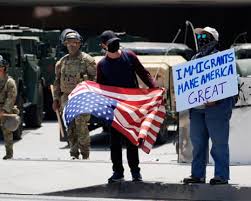

Judge’s Emergency Order Targets Racial Profiling, Legal Access Violations in Seven Counties
In a powerful legal rebuke with sweeping implications for federal immigration policy, a U.S. federal judge has temporarily blocked the Trump administration from conducting indiscriminate immigration stops and arrests across seven counties in California. The order, issued Friday by Judge Maame E. Frimpong, is a direct response to a lawsuit alleging widespread racial profiling by immigration authorities.
The injunction applies to heavily Latino areas such as Los Angeles and Ventura County, and stems from accusations that federal agents systematically targeted brown-skinned individuals based solely on ethnicity, language, and location—often without warrants or probable cause.
The decision comes amid growing scrutiny over the administration’s aggressive immigration enforcement, which advocates argue has prioritized speed, quotas, and optics over constitutional rights.
“Mountain of Evidence”: A Legal Blow to Trump-Era Immigration Strategy
Federal Agents Accused of Operating on Stereotypes, Not Facts
Judge Frimpong’s ruling is a temporary emergency measure but marks a significant legal milestone. “There was a mountain of evidence presented in this case,” she wrote, stating that the government likely violated both the Fourth Amendment (which protects against unlawful searches and seizures) and the Fifth Amendment (which guarantees due process).
The lawsuit, filed last week in U.S. District Court by immigrant advocacy groups, centers around multiple plaintiffs—three undocumented immigrants and two U.S. citizens—who claim they were unlawfully detained. One of the citizens, Brian Gavidia, said he was detained despite showing valid identification and alleges he was physically assaulted by agents merely for “being Latino in a Latino neighborhood.”
The judge’s order halts the use of vague indicators such as:
-
Skin color or perceived ethnicity
-
Speaking Spanish or accented English
-
Being at locations like car washes, farms, or tow yards
-
Occupations common among immigrant workers
These factors can no longer serve as a basis for “reasonable suspicion” to stop, question, or detain individuals.
Raids Turn Violent: Cannabis Farm Arrests Spark Protests, Injuries
Busloads Detained Mid-Hearing in Ventura County
While the court proceedings were underway, real-time evidence appeared to reinforce the plaintiffs’ claims. On Thursday, immigration agents descended on a cannabis farm in Ventura County, detaining busloads of workers—many believed to be undocumented—prompting fierce resistance from community activists.
Protesters clashed with agents, resulting in injuries and at least five people being taken to hospital. Videos of the confrontation circulated widely, galvanizing support for the plaintiffs and pressuring the court to act decisively.
The judge also issued a separate order barring federal authorities from restricting attorney access at an immigration detention facility in downtown Los Angeles, a move that immigrant rights lawyers have long demanded.
ACLU: Arrest Quotas, Stereotypes Driving Federal Operations
Lawsuit Claims Systemic Discrimination, Legal Access Denials
The American Civil Liberties Union (ACLU), which is representing the plaintiffs, argued that the Department of Homeland Security (DHS) has pursued an arbitrary arrest quota in Southern California, leading to indiscriminate sweeps based on race, not individualized suspicion.
“Immigration enforcement in the region has devolved into a dragnet operation, fueled by racist stereotypes and political theatrics,” said ACLU attorney Mohammad Tajsar. “This is not law enforcement; it’s racial profiling masquerading as policy.”
Tajsar highlighted the case of Gavidia, the U.S. citizen, as emblematic of the federal overreach. “He was assaulted while working a legal job because he looked Latino. That should never happen in America.”
Trump Officials Deny Allegations, Cite “Totality of Circumstances”
DHS Calls Profiling Accusations “Categorically FALSE”
In defense of the administration, government attorney Sean Skedzielewski argued that agents do not arrest individuals based on race alone. Instead, he said, immigration officers rely on “targeted, individualized packages” informed by prior surveillance and behavior patterns observed in the field.
DHS Assistant Secretary Tricia McLaughlin strongly pushed back on the claims, calling them “disgusting and categorically FALSE.” She insisted that “enforcement operations are highly targeted, and officers do their due diligence.”
Still, the judge’s order suggests that the court found the plaintiffs’ version more credible—for now.
Broader Implications: A New Legal Standard on Immigration Stops?
CEO Takeaway: Compliance, Diversity, and Risk in Enforcement Landscapes
For business leaders—particularly in agriculture, construction, and hospitality—this ruling serves as a loud wake-up call. It signals increasing legal risk in relying on federal immigration enforcement mechanisms that don’t align with constitutional safeguards.
Key implications include:
-
Heightened scrutiny of workplace raids and ICE detentions
-
Legal exposure for businesses found complicit in unlawful detentions
-
Increased reputational risk in communities of color
-
The need for proactive legal reviews of workplace immigration practices
Companies operating in affected counties may wish to re-evaluate HR and compliance policies to ensure that they are not inadvertently involved in racial profiling practices by association or location.
What’s Next: Lawsuit Advances, Pressure Mounts on DHS
Emergency Block Likely to Expand if Evidence Grows
The judge’s emergency order is expected to remain in place while the broader lawsuit progresses. Advocacy groups are already lobbying for similar injunctions in other states, especially in regions with large Latino populations and aggressive ICE enforcement.
If the plaintiffs succeed in proving systemic discrimination, the ruling could set a powerful national precedent, limiting how ICE can conduct enforcement operations across the country.
For now, though, the spotlight remains firmly on Southern California—and whether the federal government will revise its tactics or dig in deeper.