
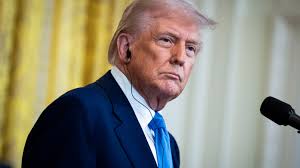
Trump’s 100% Chip Tariff: A High-Stakes Gamble to Force Semiconductor Manufacturing Back to U.S. Soil
President Donald Trump has announced a dramatic escalation in his economic nationalist agenda: a 100% import tariff on foreign-made computer chips, a move that could transform the global tech landscape and drastically raise prices on electronics, autos, appliances, and more.
But there’s a catch — companies manufacturing within the United States will be exempt. In a bold shift from incentives to penalties, the president is betting that fear of rising costs will force global semiconductor firms to bring production stateside.
The Announcement: “If You’re Building in the U.S., There’s No Charge”
Speaking from the Oval Office during a high-profile meeting with Apple CEO Tim Cook on Wednesday, Trump made the announcement with trademark bluntness:
“We’ll be putting a tariff on of approximately 100% on chips and semiconductors,” Trump said. “But if you’re building in the United States of America, there’s no charge.”
The policy, which is expected to be formally implemented next week, could have far-reaching implications for global trade, corporate profitability, and American consumers.
The Apple Deal: $600 Billion Commitment to U.S. Manufacturing
Tim Cook Secures Strategic Exemption
The timing of Trump’s announcement coincides with Apple’s newly pledged $100 billion investment in U.S. manufacturing — a deal struck just months after Cook committed $500 billion earlier this year. With this new announcement, Apple has now pledged $600 billion toward domestic operations, making it one of the largest-ever commitments to U.S. industry by a private company.
The move also effectively exempts Apple from the looming tariff impact — a crucial point given that about 90% of iPhones are currently assembled in China.
Cook has been among the few high-profile tech executives able to negotiate favorable terms with Trump, having met him multiple times since 2017. This latest meeting signals a continuation of that mutually strategic relationship, one likely to benefit Apple’s U.S. expansion plans.
Winners and Losers: Who’s Exempt and Who’s at Risk?
Exemptions for TSMC, Samsung, and U.S. Giants
Despite the aggressive tone, not every foreign producer will be impacted equally.
-
TSMC (Taiwan Semiconductor Manufacturing Company), the world’s largest contract chipmaker, has been granted an exemption, according to Taiwanese officials during a parliamentary briefing.
-
South Korea’s Samsung Electronics and SK Hynix are also not subject to the 100% tariff, as confirmed by Seoul’s top trade envoy Yeo Han-koo.
-
U.S.-based firms like Nvidia and Intel are likely unaffected, thanks to their U.S.-based fabs and operations.
These exemptions reveal a clear pattern: companies investing in U.S. facilities are being spared, reinforcing Trump’s message that manufacturing must be brought home.
Southeast Asia at Risk: Philippines Rings the Alarm
The broader Asian semiconductor ecosystem, however, isn’t so lucky. Dan Lachica, head of the Philippine Semiconductor and Electronics Industries, warned the tariff would be “devastating” for his country — where semiconductors account for roughly 70% of exports.
Other nations heavily reliant on chip exports, including Malaysia, Vietnam, and Thailand, may soon face supply chain crises and employment shocks if U.S. customers pivot away from their components.
Strategic Shift: From Biden’s Carrots to Trump’s Stick
Two Philosophies, One Goal
Trump’s approach contrasts sharply with the Chips and Science Act signed by President Joe Biden in 2022. That legislation offered $50 billion in subsidies, tax credits, and research grants to encourage domestic chip production.
Biden’s model: incentivize growth through public-private partnerships.
Trump’s model: penalize offshore manufacturing and reward American soil.
“The Trump strategy is simple,” said a senior administration official. “Make it more expensive to build abroad than it is to manufacture in the U.S.”
This “carrot vs. stick” contrast underscores the partisan divide on industrial policy — yet both aim to reclaim semiconductor sovereignty and reduce American dependence on foreign chipmakers, especially amid geopolitical tensions with China.
What It Means for U.S. Consumers
Higher Prices for Phones, TVs, Cars — at Least in the Short Term
While the long-term vision is to onshore semiconductor manufacturing, the immediate impact may be painful for American consumers. Prices for:
-
Smartphones
-
Laptops
-
Cars
-
TVs
-
Refrigerators
-
Gaming consoles
…are expected to rise significantly, especially if companies cannot pivot fast enough to avoid the new levies.
This move comes despite inflationary pressures that continue to weigh on the U.S. economy post-pandemic. The 2020s chip shortage, triggered in part by COVID-era shutdowns, exposed just how fragile global supply chains really are — and why U.S. policymakers from both parties now see chip independence as a national security priority.
Global Semiconductor Demand Still Surging
Despite trade threats and cost spikes, demand for computer chips continues to grow at a rapid pace. According to the World Semiconductor Trade Statistics (WSTS), global chip sales rose 19.6% in the 12 months ending in June 2025.
This underscores the paradox: while tariffs may strain supply chains, global dependence on semiconductors — from AI to automotive to defense — remains non-negotiable.
The Bigger Picture: Will Trump’s Tariff Threats Work?
Manufacturing Renaissance or Corporate Backlash?
Trump’s 100% chip tariff is arguably his most aggressive trade policy yet, targeting the backbone of the digital economy. The question now is whether:
-
Foreign manufacturers will rush to build U.S. plants, or
-
Corporations will push back against profit-margin pressures and rising costs.
This could ignite a new wave of investment — or spark a global trade war centered on chips, not steel or soybeans.
Trump’s Gamble with America’s Digital Future
Trump is betting that the stick will succeed where incentives have failed. With the stakes involving national security, inflation, and global tech dominance, the semiconductor tariff may become the defining economic policy of his presidency.
Whether it proves visionary or self-destructive depends on how fast global companies can adapt — and whether U.S. consumers are willing to pay the price of protectionism.