
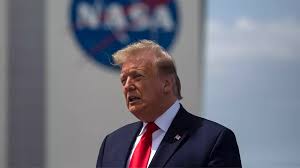
Trump’s NASA Cuts Spark Alarm: 2,145 Jobs on the Line, Science Programs in Jeopardy
The Trump administration is moving forward with a dramatic workforce reduction at NASA, targeting at least 2,145 high-level employees in what insiders and former agency leaders are calling an existential threat to America’s leadership in space exploration.
According to internal documents obtained by Politico, the cuts will impact both senior scientists and mission support professionals, stripping NASA of decades of institutional knowledge and project continuity. This initiative, part of a broader federal downsizing strategy involving early retirements and buyouts, comes on top of proposed 47% cuts to NASA’s science budget for FY 2026.
The news has sent shockwaves through the aerospace industry, Capitol Hill, and among global partners that rely on NASA for scientific collaboration and technological breakthroughs.
Inside the Numbers: What’s Being Cut—and Who’s Being Lost
Over 1,800 Staff in Core Mission Areas Set for Removal
The reported breakdown shows that 1,818 of the 2,145 affected employees are in NASA’s core scientific and human spaceflight divisions. The remaining cuts are directed at critical support roles—especially in IT and administrative operations—further destabilizing the agency’s infrastructure.
These aren’t junior roles. Most impacted employees are senior specialists or leaders, many with decades of experience in fields such as:
-
Astrophysics and planetary science
-
Human spaceflight and engineering
-
Satellite climate monitoring
-
Advanced computing and mission design
Bethany Stevens, a NASA spokesperson, responded tersely to press inquiries:
“NASA remains committed to our mission as we work within a more prioritized budget.”
But critics say this is not budgeting—it’s dismantling.
Industry Leaders Condemn the Cuts: “A Catastrophic Mistake”
Seven Former Science Chiefs Sound the Alarm
In a rare show of unity, seven former heads of NASA’s Science Mission Directorate submitted a scathing joint letter to Congress last week, warning that the Trump administration’s proposals threaten not just space science, but national economic and security interests.
“The economics of these proposed cuts ignore a fundamental truth: investments in NASA science are a powerful driver of U.S. technological leadership,” they wrote.
The letter highlighted how past NASA science initiatives have yielded:
-
Mars rovers landing with pinpoint precision
-
The James Webb Space Telescope revolutionizing our understanding of the cosmos
-
Solar probes enduring extreme temperatures
-
Climate satellites tracking planetary health
-
Small satellites supporting agriculture, communications, and disaster relief
Cutting these programs, the scientists warned, risks handing global leadership to a rising competitor: China.
Global Implications: Ceding Space Leadership to Beijing?
China’s Space Program Ramps Up As U.S. Retreats
The letter to Congress also noted that while the U.S. cuts back, China is accelerating its space ambitions—with plans to:
-
Return samples from Mars
-
Launch Neptune exploration missions
-
Build out advanced climate monitoring systems
-
Expand telescope missions to study the deep universe
All of these are areas where U.S. programs face cancellation under the FY 2026 proposal.
“The Chinese space science program is aggressive, ambitious, and well-funded,” the former NASA leaders warned. “The U.S. is signaling retreat.”
For the private sector—including aerospace firms, satellite companies, and R&D contractors—this shift could have enormous implications, both in terms of lost contracts and long-term innovation pipeline disruption.
Chaos at the Top: NASA Still Without an Administrator
Jared Isaacman Nomination Withdrawn in Musk Feud
As the agency faces one of the greatest threats in its history, it remains leaderless. The Trump administration abruptly withdrew its nomination of billionaire private astronaut Jared Isaacman—reportedly in retaliation against Elon Musk, CEO of SpaceX.
In a Truth Social post on Sunday, Trump wrote:
“I thought it would have been inappropriate that a very close friend of Elon, who was in the Space Business, run NASA, when NASA is such a big part of Elon’s corporate life.”
This political maneuvering leaves NASA rudderless as it faces budget implosions, staffing crises, and international competition.
Strategic Takeaways for the C-Suite
4 Risks and Realities CEOs Must Watch
For aerospace executives, defense contractors, and tech leaders with deep NASA ties, the implications are immediate and wide-ranging:
-
Program Cancellations: Expect a cascade of delayed or terminated missions affecting suppliers and subcontractors.
-
Talent Drain: Senior scientists exiting NASA may spark a talent war in the private sector.
-
R&D Headwinds: Slashed science budgets will slow innovation cycles dependent on federal breakthroughs.
-
Geopolitical Shifts: China’s expanding dominance in space science could shift strategic partnerships and global priorities.
A Reckless Retreat or Realignment?
President Trump’s planned layoffs and science budget cuts are being pitched as fiscal discipline. But to many scientists, business leaders, and former NASA officials, they amount to an ideological assault on American leadership in space.
The administration’s strategy—mixing political loyalty tests with anti-establishment rhetoric—may please certain voter blocs. But without a functioning, science-driven NASA, the consequences could echo across industries, economies, and generations.
The coming months will test whether Congress, private industry, and the American public are prepared to defend one of the nation’s most iconic institutions—or let it fall victim to what critics call short-term politics and long-term blindness.