
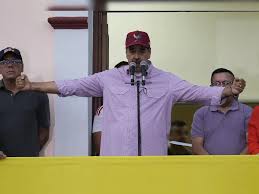
A Historic Reward in the Crosshairs of Global Politics
The Trump administration has dramatically escalated its pursuit of Venezuelan President Nicolás Maduro, doubling the U.S. reward for his capture to $50 million — a figure on par with the most notorious manhunts in modern history.
Framing Maduro as one of the world’s most dangerous narcotraffickers, U.S. officials allege he has worked with powerful cartels to smuggle fentanyl-laced cocaine into the United States, posing a direct threat to national security.
Pam Bondi: “Maduro Will Not Escape Justice”
The Administration’s Message
In a video statement on Thursday, Attorney General Pam Bondi said:
“Under President Trump’s leadership, Maduro will not escape justice and he will be held accountable for his despicable crimes.”
Bondi emphasized that the U.S. Department of Justice has already seized over $700 million in assets linked to Maduro, including two private jets. She claimed that U.S. authorities have intercepted seven million tons of cocaine traced directly to the Venezuelan leader’s network.
From $15 Million to $50 Million: The Bounty’s Evolution
A Multi-Administration Hunt
-
2020 (Trump’s first term): Maduro indicted in Manhattan federal court for narcoterrorism and conspiracy to import cocaine, alongside key allies. Original bounty: $15 million.
-
Biden administration: Raised to $25 million, matching the amount offered for Osama bin Laden in 2001.
-
2025 (Trump’s second term): Doubled again to $50 million, signaling an intensified push for arrest.
Why Maduro Remains in Power
Despite being indicted and sanctioned by the United States, European Union, and several Latin American governments, Maduro has consolidated power in Venezuela. His 2024 re-election was widely condemned as fraudulent, with many nations recognizing his opponent as the legitimate president.
Yet, through a mix of domestic control and geopolitical maneuvering, Maduro has so far evaded removal — or capture.
Recent U.S.–Venezuela Dealings Add Complexity
A Controversial Prisoner Swap
Last month, the Trump administration negotiated the release of 10 Americans jailed in Caracas. In return, the U.S. deported scores of Venezuelan migrants to El Salvador under its tightened immigration policies.
One of the freed Americans, Dahud Hanid Ortiz, is a former U.S. soldier convicted in Spain of triple homicide in 2016. His inclusion in the swap sparked outrage from victims’ advocates.
Chevron’s Return to Venezuela
In a surprising policy reversal, the White House soon allowed Chevron to resume oil drilling in Venezuela, lifting a sanctions ban that had been in place for years. Critics argue this undercuts the administration’s hardline stance.
The Tren de Aragua Connection — Fact or Political Tool?
White House Allegations
Bondi and other officials claim Maduro has direct ties to Tren de Aragua (TdA), a Venezuelan gang accused of violent crimes across Latin America and the U.S. According to Bondi:
“Maduro uses foreign terrorist organizations like TdA … to bring deadly violence to our country.”
Expert Pushback
Security analysts caution that while the Venezuelan state has historically tolerated TdA’s operations, no evidence proves the gang is acting “at the direction” of Maduro. A National Intelligence Council report earlier this year found low-level contacts but no command relationship.
Collateral Damage: The Case of Andry José Hernández Romero
In a high-profile example of the administration’s tough stance on Venezuelan immigration, Andry José Hernández Romero, a gay asylum seeker and makeup artist, was deported to El Salvador after U.S. authorities claimed his tattoos proved TdA affiliation.
Advocates argue this case — and others like it — demonstrates how the administration’s rhetoric is fueling due-process violations against Venezuelan migrants.
Political and Strategic Implications
Why the Bounty Matters
By setting such a high price on Maduro’s capture, the U.S. sends a dual message:
-
International allies — that Washington is committed to dismantling what it sees as a criminal regime.
-
Domestic audience — that the administration is taking aggressive action against perceived threats tied to illegal immigration and drug trafficking.
The Diplomatic Balancing Act
However, the administration’s simultaneous prisoner swap, oil concessions, and bounty escalation reveal the complex interplay between diplomacy, security, and economic interests.
The $50 Million Question
Whether this record-setting reward will bring Maduro to justice remains uncertain. He retains the backing of Venezuela’s military apparatus and key international partners like Russia and Iran.
For now, the bounty serves as both a symbolic escalation in the U.S. campaign against his rule and a political tool in the Trump administration’s broader law-and-order and immigration agenda.
The real test will be whether this move produces tangible results — or simply fuels another chapter in the decades-long U.S.–Venezuela standoff.